After the busy weekends I appreciate a little slower Monday to catch up on things and be quiet for a while. Unfortunately the same can’t be said for Father Roman, who is often booked to drive into Jerusalem and contend with traffic. When I first met him I thought his somewhat strict daily resting schedule was strange, maybe even indulgent. I’m beginning to see its wisdom. Nonetheless he seemed in no mood to slow down, and had quite the adventurous week planned for us.
Tuesday afternoon we left for Arad, a city about an hour away to visit with a Canadian (!) artist named Rick Wienecke. He has a sculpting studio and his own personal bronze foundry behind the house. For real. He also has created a true mind-blower of an exhibit called Fountain of Tears. Click here to go to his site and learn more about it. I’ll let him and his site explain the bulk of it, but needless to say it is astonishing to be there and walk through it, first alone with only your thoughts and reactions to guide you, then again with him as he answers questions and entertains any kind of comment and inspired idea.
The historical relationship between Christians and Jews is complicated and at times has been ravaged with injustice, to put it mildly. The situation today could be seen as an improvement of varying degrees, and maybe has the potential to continue moving in a good direction. Through his exhibit Rick has entered into one of the most difficult discussions on the docket. Thankfully he is a deep, deep thinker and truly cares about bringing these two groups into dialog at a heart level through an incredibly tangible encounter. Kudos to him, and if I get back to Israel I hope to spend time learning more about it.
We timed our departure from Rick’s place to arrive an hour later at the Dead Sea for some bob-and-float time. You see, if you arrive after 7:00pm, you don’t have to pay for parking. Yes, we’re that frugal around here. There’s the additional benefit of the temperature being a little lower than “inferno” later in the day. But that east wind still feels like a mountain-sized hair dryer pointed right at you.
Nevertheless, a lovely time. “So zen,” I told Father Roman. He raised an eyebrow and replied, “What’s this? You’re talking about Eastern meditation philosophy?” “No, in Western English anything that is relaxing could be said to be ‘so zen'”. “Ah.”
The evening worship sessions back at our chapel were becoming more rhythmic for me, in terms of where to put the musical pieces for parts of the service, and I learn new bits each week. Father Roman is so keen for music in the worship, he wouldn’t mind the whole thing sung. Mostly. “Greg, you can sing everything, just not the special priestly bread-and-wine prayer. That’s my bit.” Noted. We both have an appetite for simplicity and beauty. I will miss these times a lot when I’m back home.
Thursday was another grand day out. We left early to visit one of the places I had not managed to get to yet: Bethlehem. Bethlehem resides in Palestine, and getting in and out of there is just a little tricky these days. But Father Roman is a veteran at this stuff, and felt confident we could navigate ourselves over to the Church of the Nativity, where the birth and early infancy of Jesus is celebrated.
But first a surprise. Father Roman thought it would be good to take me to Rachel’s tomb (Rachel is Jacob’s wife and mother of their son Joseph—think coloured coat), located in the Bethlehem area. We arrived there and went inside the men’s section, which has a separate entrance from the women’s section. I think we were the only non-Jewish guys in the place. Men must keep their heads covered here, and my aussie-style hat qualifies as valid cover. I thought it looked a little out of place, but I had to be what I was in that moment. There were a lot of people there, praying or reading scripture or meditating. Inside the building is the tomb proper.
You see, my scripture reading schedule had just recently concluded the section on Joseph (at the end of Genesis), and so this stuff was fresh in my mind and imagination. One of the tragedies in the Rachel story is that she dies right after the birth of her second son, Benjamin. I think about Joseph and his younger brother growing up without their mom and the additional layer of trauma added to their lives. Standing at her tomb, to me it all became very real in a moment, and the humanity of her, her husband and her children made it extra heavy with meaning.
We then went over to the Church of the Nativity. It was very nice and had several additional historical sections to it. It seems this place has been very important to many Christians pretty much from the beginning. Father Roman knows one of the nearby gift shop owners very well, and the merchant did a marvellous job of herding us into his shop to talk with us and serve us a coffee. I’ve mentioned it elsewhere in my writings: these days there are few tourist and pilgrims, even less so on the Palestinian side of things. I don’t know how these folks get by.
This being one of my last opportunities for collecting holy swag, I had to ask him if he had any of the “good stuff”—really nice incense, and not the crumbs usually sold to tourists. He made a serious face and nodded knowingly, then returned a moment later with a box of heavenly-smelling nard beads. I was helpless. I bought it. As we left he took out a couple of tiny olivewood gifts and handed them to me in gratitude and brotherhood.
We made our way somewhat delicately across the checkpoint and back to the Israel side of the line. Father Roman drove us to the spot he was to have some meetings later that day to show me a neat little place called the Sukkat Hallel (literally “tent of praise”). It’s a worship space run by a few Christian groups in collaboration. This upper-floor room has a special feature: they schedule musicians to come to the room 24 hours a day and provide a meditative atmosphere. Ambitious, I thought. And upon walking into the room, impactful. I’ve written about places like the Holy Sepulchre that are so soaked in devotion that you can’t help but have some rub off on you when you’re there. This place was similar, even if it was more a newcomer in comparison.
We left there after just a brief visit to meet up with Father Piotr one last time (for me) before I left. He led us to a nearby burger shop of his liking. The meals were good, and my lamb burger with pesto and a side of onion rings was very satisfying. It was nice to catch up with him after a few weeks away, and discuss some ideas about my potential return to Israel and more volunteer work for the Hebrew-speaking Catholic community in the future.
Father Roman then took off for his meetings, and I took one last walk through the old city over to the Church of the Dormition, where the death of Mary (Jesus’ mom) is remembered. The crypt is on the lower floor, with beautiful but simple art and architecture all over. The caretaker booted everyone out at 5:00, and I veered over so I could take a last look in their gift shop. Maybe I’m such a westerner, but I am a sucker for the olive wood carvings—I just love those. In this particular shop I finally saw a piece of carving that I had only imagined could exist, and here it was staring at me. I was helpless. I bought it. It wasn’t large and would easily fit in my small luggage, which helped justify the whole indulgence.
I left the old city and walked across the Ben Hinom valley back towards the Sukkat Hallel. On the way was a neat cultural hub called First Station. This place has restaurants, pubs, coffee shops and a large open square which that day was filled with dozens and dozens of book sellers. If you’ve been to Granville Island market in Vancouver you kind of know what I’m talking about. My Google search told me there was a very good coffee stand there, so I went over and ordered an iced Americano. Wow. Worth it.
I then walked over to one last stop at the Sukkat and spent a little more time soaking in the vibe. So zen, you might say. The room had two large windows which overlooked the old city and the adjacent “city of David” Arabic section of Jerusalem. Father Roman finished his meetings and met me there, and we got back in the car and headed home for Beersheva. A day full of emotion and wonder.
Saturday morning Father Roman and I again joined the Messianic Christians for worship and then went over with fellow parishioners Pau (94 years old and plays the organ for our Hebrew worship), his wife Hannah and their son Nati to their house for lunch. Hannah had prepared the works for us, starting with soup, then the mains with all the meats and veggies. Pau insisted on his traditional Catalonian dessert of fresh fruit, and Hannah added to this her traditional Dutch desert preference of some sweet dairy treat, in this case a cheesecake.
Father Roman and I then drove back home to prepare the chapel and ourselves for my final English Mass. One special visitor that day was a Russian ex-pat who had to escape his home country after voicing his ideas about the war in the Ukraine. His first political detention only lasted a month. His second was going to be much, much longer. So he thought the better and came to Israel to be with his mom who had emigrated here some years ago.
Sunday was a simple day, finishing with my final Hebrew Mass with the larger community. It was hard to say goodbye to these folks. The thought of returning in the future takes out some of the sting.
Highlight: It was so great to be at First Station and observe regular people just do their regular social things. I loved watching families enjoy recreation time, and especially these two very young girls stuffing their faces with cheese and olive pizza, momentarily oblivious to any of the other larger problems present in the world.
Thankful for: Rachel and all those who gave their lives so that this amazing story, of which I am a part, could continue.
Pray for: someone to blink first. We all have reasons to be angry with whoever did the crime against us. But which one of us will be the first to say no to grudge and revenge?
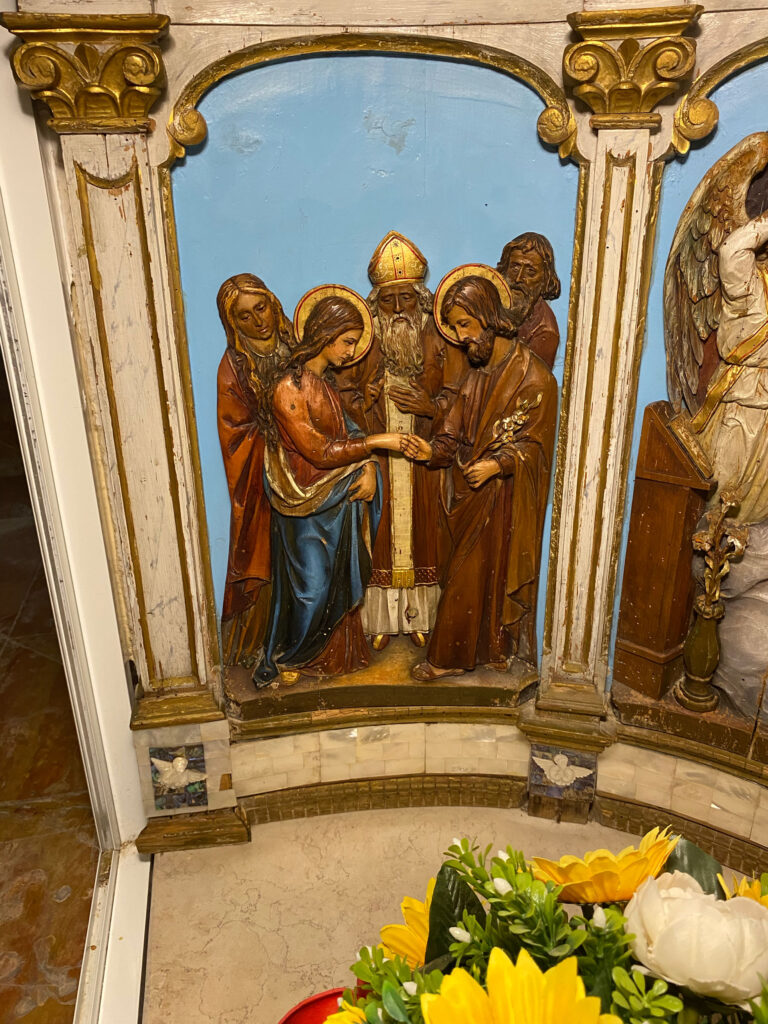
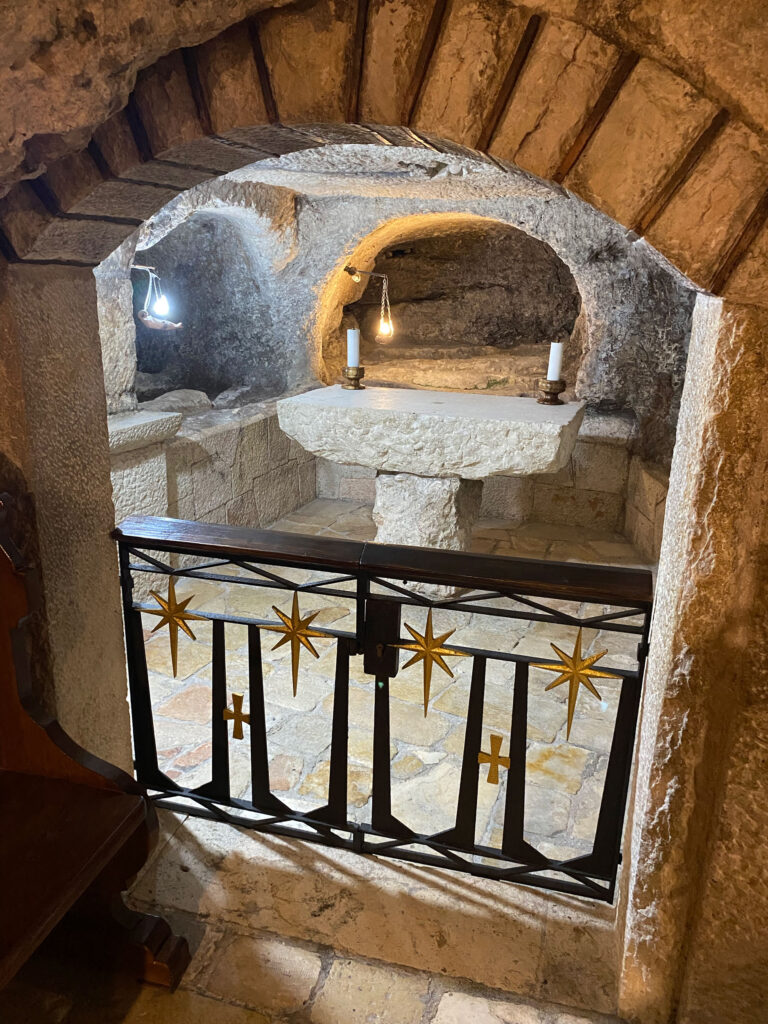
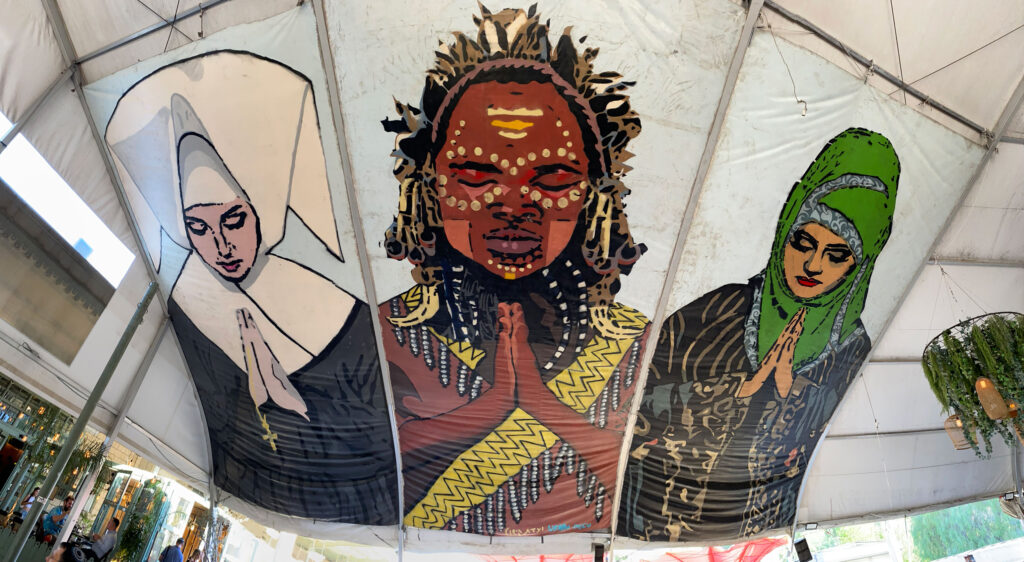
Photos: 1) On the lower level of the Church of the Nativity is a section with small carved panels. This one shows the marriage ceremony of Mary and Joseph, which I thought was unique, and I like the fist pump. 2) Also at the Nativity site is a place to remember the infant and toddler boys killed in the atrocity known as the Massacre of the Innocents. The platforms behind and beside the table are ancient tombs where their bodies would have been laid. 3) This triptych was on the underside of the huge tent roof that covers part of the First Station market in Jerusalem. It’s encouraging to see disparate images like these so closely connected. Someone is thinking.